Over the last 18 months, I have spoken with business owners, CROs, customer success leaders and enterprise teams across the US, UK, UAE, Dubai, Australia and the wider Middle East.
One pattern keeps repeating.
Companies that invested in chatbots a few years ago are now questioning whether those systems still create business value. The answer is increasingly becoming “no.” Customers expect intelligent conversations. Sales teams expect qualified opportunities. Executives expect measurable ROI. Unfortunately, traditional chatbots were never built to meet those expectations.
The debate around AI agents vs chatbots is now a business growth discussion.
Are you an organization that continues relying on scripted chatbot flows? Then you are at grave risk of losing leads, frustrating customers and giving competitors a significant advantage.
Why Rule-Based Chatbots Are Failing in 2026
Traditional chatbots operate using predefined rules.
They follow scripts, recognize specific keywords and respond based on predetermined decision trees.
The problem appears when customers behave like real humans. A prospect may ask multiple questions, change topics, provide incomplete information or require personalized assistance. Most chatbots struggle immediately.
When evaluating an AI agent vs rule based chatbot, the difference becomes obvious.
- A rule-based chatbot can answer.
- An AI agent can understand, reason, decide and act.
According to Grand View Research, the global AI agents market was valued at approximately USD 7.6 billion in 2025. And it is projected to reach nearly USD 183 billion by 2033, growing at a CAGR of almost 50%. North America currently represents the largest market share.
This is why businesses searching for a modern rule based chatbot alternative are rapidly moving toward AI-powered agentic systems.
The Hidden Cost of Legacy Chatbots
Many organizations underestimate how much outdated chatbot technology actually costs. Conversation around AI agent vs rule based chatbot has become a boardroom discussion rather than an IT discussion. The biggest expense is a lost opportunity due to:
- Revenue leaks through unqualified website visitors.
- Enterprise opportunities disappear without human follow-up.
- High-intent buyers abandon conversations prematurely.
- Slow responses reduce conversion potential significantly.
- Sales teams receive poor-quality lead data.
- Customer trust declines after failed interactions.
- Competitors capture prospects seeking immediate answers.
- Limited personalization weakens buying confidence.
- Complex inquiries remain unresolved for prospects.
- Growth stalls despite increasing website traffic.
AI Agents vs Rule-Based Chatbots: The Real Difference
The discussion around AI agents vs chatbots often misses a critical point. Businesses now no longer buy technology, they need quick results.
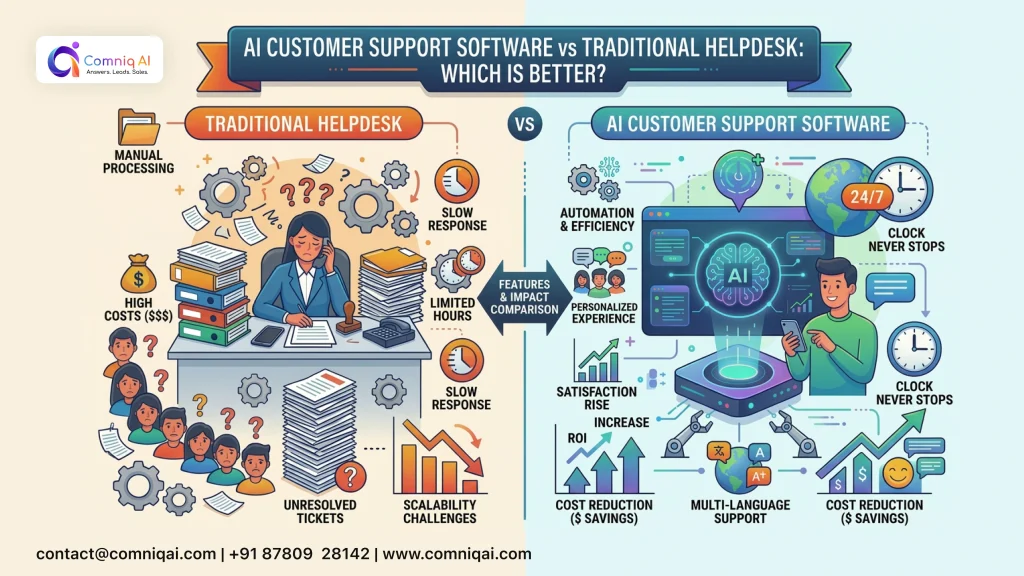
| Rule-Based Chatbot | AI Agent |
| Follows scripts | Understands intent |
| Answers questions | Solves problems |
| Reactive | Proactive |
| Limited workflows | Multi-step execution |
| No reasoning | Context-aware reasoning |
| Minimal personalization | Personalized engagement |
| Cannot take actions | Can perform actions |
This shift is driving one of the fastest-growing technology categories globally.
ChatGPT Is Not an AI Agent
One of the biggest misconceptions among executives is confusing ChatGPT with an AI agent. The debate around Chatbot AI vs ChatGPT often overlooks what businesses actually need. ChatGPT is exceptional at generating responses. But generating responses is not the same as executing tasks.
Modern AI agents can:
- Update CRM records
- Schedule meetings
- Trigger workflows
- Route support tickets
- Qualify leads
- Access knowledge bases
- Execute business processes
That distinction matters. An AI agent for customer service does not simply answer questions. It actively helps resolve issues while performing business actions behind the scenes.
Real Business Scenarios Where AI Agents Win
Consider a logistics company in the UK. A prospect arrives on the website after business hours. Instead of providing generic answers, the AI agent understands shipment requirements, captures company information, qualifies the opportunity and schedules a meeting. The sales team wakes up to a qualified lead.
Now consider a healthcare provider in Dubai. An incoming patient inquiry requires routing to the appropriate department. The AI agent gathers information, answers questions and books a consultation automatically.
In Australia, all leading SaaS companies deploy AI agents for lead generation to identify buying intent, nurture prospects and qualify opportunities before involving sales representatives.
Meanwhile, a US-based manufacturing company uses AI agent software for website lead generation to engage distributors and enterprise buyers around the clock.
These are practical business applications happening today. So where does your business stand amid this? Think!!
Why B2B Companies Are Moving Faster Than Everyone Else
B2B organizations face unique challenges. Sales cycles are longer, lead values are higher and customer expectations are increasing.
So, enterprises are replacing traditional systems with an AI chatbot for customer service. This extends beyond support and contributes directly to revenue growth.
Industries leading adoption include:
- SaaS
- Financial Services
- Manufacturing
- Healthcare
- Logistics
- Professional Services
- So on and so forth….
The reason for vast and fast adoption is simple: AI chatbot with automation can work 24/7 without increasing headcount. When combined with intelligent decision-making, that capability becomes a significant competitive advantage.
Why Choose ComniqAI for Your AI Chatbot Needs
Organizations looking for an enterprise AI chatbot solution increasingly realize that answering questions is only a small part of the equation. Generating revenue is the bigger opportunity.
But then, most vendors still sell chatbots. ComniqAI was built to deliver business outcomes. Our vision goes beyond conversation. We have created an AI agent platform for businesses designed to engage, qualify, automate, convert and support customers across the entire lifecycle.
Unlike conventional chatbot solutions, ComniqAI combines:
- Intelligent conversations
- Workflow automation
- CRM integration
- Lead qualification
- Sales acceleration
- Customer engagement
- Knowledge retrieval
All these combine to transform a simple website interaction into a measurable business opportunity.
The ROI Business Leaders Actually Care About
Technology investments must produce measurable returns. An advanced AI chatbot with automation does not merely reduce workload. It creates capacity for growth. Similarly, an AI chatbot for customer service can improve customer experiences while simultaneously reducing operational costs.
That is why companies are increasingly adopting AI agents for lead generation and deploying intelligent automation across customer-facing operations.
Typical outcomes include:
- Faster response times
- More qualified opportunities
- Reduced support costs
- Higher customer satisfaction
- Better conversion rates
- Increased operational efficiency
The Market Momentum Is Impossible to Ignore
The growth numbers tell a compelling story.
Grand View Research projects the Middle East AI market to reach approximately USD 265 billion by 2033. It is fast growing at a CAGR of 41.8%, with the UAE and Saudi Arabia leading enterprise adoption.
At the same time, North America continues to dominate global AI agent adoption. The UK and Australia are accelerating investments in enterprise AI transformation.
Businesses are now asking how quickly they can deploy Agentic AI.
The Future Belongs to Intelligent Agents
The future is the combination of the best enterprise AI chatbot solution with better scripts as well as agentic AI.
Businesses evaluating an AI agent vs traditional chatbot approach must think beyond customer support and focus on business outcomes. If your organization is looking for the best AI agent to replace rule based chatbots, now is the time to explore ComniqAI.
Book a demo, evaluate real-world use cases and signup to discover how intelligent agents can transform conversations into measurable revenue growth.