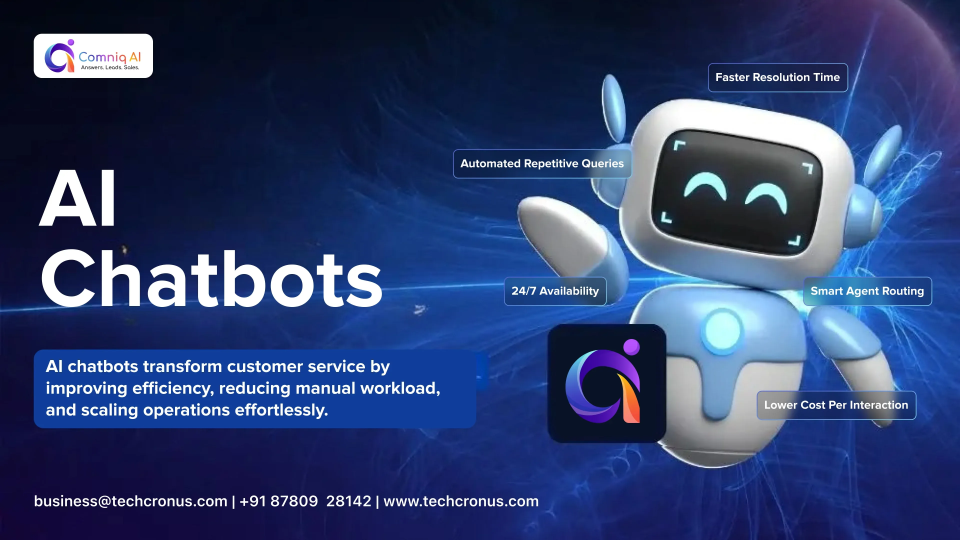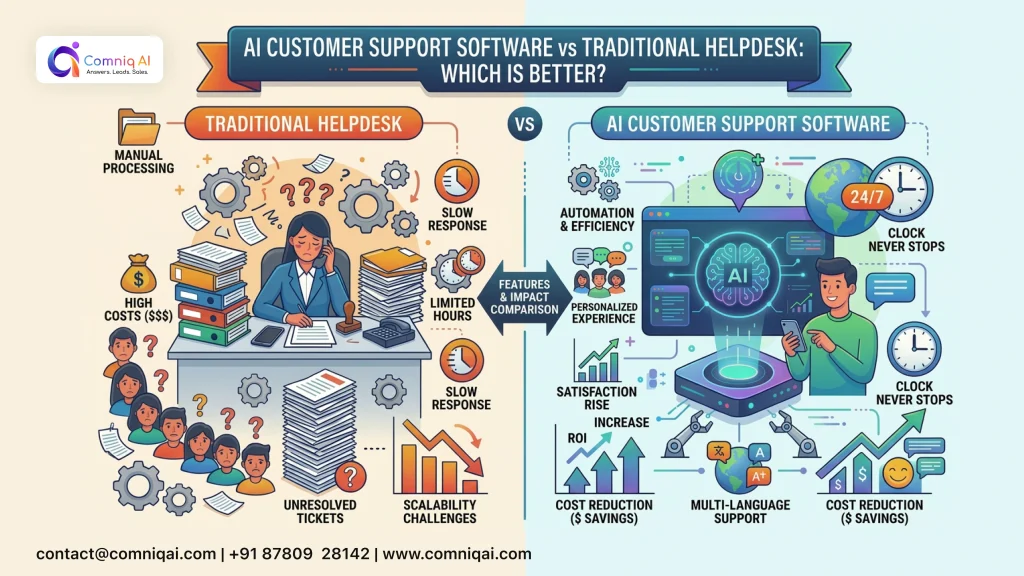
The AI chat bot vs chatgpt comparison shows that AI chat bots suit structured tasks like FAQs and order tracking, offering control and lower costs. ChatGPT by OpenAI supports open-ended, creative conversations but needs more oversight. Many businesses benefit from using both in a hybrid approach.
Why “AI chat bot vs ChatGPT” matters
People are now used to chatting with a business before they ever talk to a human. From tracking an order to asking a quick question, chat tools are everywhere, and they’ve become a core part of customer experience.
But with their evolution has come confusion. For years, a “chat bot” was simple and scripted. Today, AI has introduced terms like AI chat bot and ChatGPT, and many assume they all mean the same thing when they actually work very differently.
And that difference matters. It affects how much the tool costs, how natural the conversation feels, how reliable the answers are, and whether the solution can scale with your business. In short, understanding the gap between traditional/AI-powered chat bots and generative platforms like ChatGPT helps ensure you choose a tool that truly supports your users and goals.
What is ChatGPT, and what is a Chatbot?
- A “chat bot” broadly refers to any software application designed to converse with humans, typically via text (or voice). It aims to mimic human-like conversation and answer user queries.
- However, not all chat bots are equal. Many are rule-based or scripted bots, operating on predefined decision trees. Some are AI-enabled chat bots, trained on domain-specific data but still limited in scope.
ChatGPT represents the more advanced end of the spectrum: a generative AI chat bot built on large-scale language models (LLMs) that can dynamically generate responses, understand context, handle open-ended requests, and often produce surprisingly “human-like” text.
Key Differences: AI Chatbot vs ChatGPT
Here’s how traditional/AI-powered chat bots and generative AI like ChatGPT compare across important dimensions:
| Aspect | Rule-based / AI-powered Chatbot | ChatGPT (Generative AI Chatbot) |
| Response type | Pre-defined responses, templates, or selected replies based on keywords/intent. | Dynamically generated sentences formed on-the-fly, relevant to the user prompt and context. |
| Flexibility & breadth | Limited to the scenarios scripted or trained; struggles if user deviates. | Very broad can answer questions across domains, handle complex or open-ended queries. |
| Context awareness/conversation flow | Often “stateless” or limited to recent user input; poor at multi-step or branching dialogue. | Maintains context, remembers prior messages, supports nuanced multi-step dialogues. |
| Use-case suitability | Good for FAQs, order tracking, fixed workflows (e.g. booking, support, password resets). | Better for creative tasks, content generation, dynamic support, brainstorming, open-ended customer queries. |
| Cost and maintenance | Low cost, easy to set up, minimal ongoing maintenance. | Higher compute and maintenance cost; may require supervision, fine-tuning, monitoring for errors. |
| Reliability/control | High predictability you know exactly what the bot will say. Ideal for compliance-heavy or regulated contexts. | Less predictable generative responses may occasionally be inaccurate, irrelevant, or even produce “hallucinations.” |
AI chat bot vs chatgpt: Which Should You Choose When and Why
Given the differences, here’s a pragmatic guide:
- When to pick a traditional or AI-powered chat bot:
- You expect high volume of repetitive, predictable queries (e.g. FAQs, order status, booking confirmations).
- You operate in a compliance-heavy or highly regulated domain (e.g. financial services, healthcare) where consistent wording, audit trails, and predictable replies matter.
- Budget/infrastructure is limited; you want low cost and minimal overhead.
- You need complete control over what the user sees.
- You expect high volume of repetitive, predictable queries (e.g. FAQs, order status, booking confirmations).
- When ChatGPT (or generative AI) makes sense:
- You need flexible, human-like conversations, or expect unstructured, dynamic user queries.
- Use cases involve creative content generation, brainstorming, marketing, internal knowledge work, support for complex or diverse user needs.
- You can invest in infrastructure, monitoring, and iterative improvement to manage generative AI drawbacks.
- You want to provide a richer user experience that feels less robotic, especially valuable for engagement, content, or branding.
- You need flexible, human-like conversations, or expect unstructured, dynamic user queries.
As pointed out by GETA AI, many businesses find that traditional or AI-powered chat bots cover most customer-facing needs; generative models like ChatGPT are often better suited for internal use or creative tasks.
Real-world Considerations & Trade-offs
- Cost vs value: While generative chat bots give superior conversational quality, they demand far more in compute resources and maintenance (fine-tuning, monitoring for errors). For many businesses, this cost may not justify the added benefit, especially for simple support tasks.
- Risk of incorrect or unpredictable answers: Generative models, including ChatGPT, may produce plausible-sounding but incorrect or misleading answers (“hallucinations”). This is problematic for sensitive domains (e.g. legal, medical).
- Maintenance and monitoring: Unlike rule-based bots that “set and forget,” generative chat bots need ongoing oversight for accuracy, bias, compliance, and evolving user needs.
- User expectation & trust: A generative chat bot sets user expectations high: people expect coherent, “human-like” replies. When the bot fails or gives odd responses, trust may erode faster than with a basic chat bot whose limitations are clear.
How to Use This Insight: Practical Advice
If you’re a business owner, product manager, or developer deciding between a chat bot or ChatGPT-style solution, here’s a quick decision framework:
- Map your use-cases. Document what your users typically ask for. Is it mostly repetitive (FAQs, scheduling), or diverse/unpredictable (complex questions, content generation, open-ended support)?
- Assess infrastructure & resources. Generative AI needs more compute power, maintenance, and human oversight. Do you have the capability and budget?
- Evaluate risk & compliance. In regulated sectors, finance, healthcare, legal, predictable, and auditable answers often trump conversational richness.
- Consider hybrid solutions. Many companies combine approaches: use traditional/AI-powered chat bots for standard tasks and a generative AI like ChatGPT for advanced queries, content creation, or internal tools.
Monitor and iterate. If adopting generative AI, set up feedback cycles: user feedback, accuracy checks, and periodic audits to avoid drift, misinformation, or user frustration.
Choosing the Right Option for Your Business, and Where ComniqAI Fits In
Understanding the difference between a general AI like ChatGPT and a purpose-built AI chat bot is essential when deciding what to deploy on your website. ChatGPT excels at broad, open-ended conversations, while AI chat bots are optimized for accurate, predictable, business-specific responses.
ComniqAI applies this principle by focusing on structured, reliable customer support. Because it is trained on your website content, product details, and internal documents, it responds with brand-specific accuracy, making it ideal for FAQs, order inquiries, lead capture, and routine support flows.
If your goal is dependable, on-brand customer assistance rather than open-ended dialogue, a domain-trained AI chat bot like ComniqAI is the practical and cost-efficient choice.
Conclusion
The comparison between AI chat bot vs ChatGPT is not about crowning a “winner,” but about choosing the right tool for the right job. Traditional or AI-powered chat bots remain practical, cost-effective, and predictable, ideal for structured, repetitive tasks. On the other hand, generative AI chat bots like ChatGPT offer flexibility, breadth, and human-like conversation, but come with trade-offs in cost, complexity, and reliability.
Before you invest in a chat bot solution, carefully assess your business needs, user expectations, resources, and risk tolerance. Often, the best approach is a hybrid model, combining the strengths of rule-based/AI chatbots and generative AI, to deliver both efficiency and quality.
By understanding the distinctions and trade-offs, you can build a chat bot strategy that delivers real value, whether it’s through a lean, efficient FAQ bot or a dynamic, intelligent assistant.