Customer expectations have fundamentally changed. Today’s consumers demand instant responses, personalized experiences, and 24/7 availability, expectations that traditional helpdesk systems increasingly struggle to meet. As businesses face mounting pressure to deliver exceptional service while controlling costs, the AI customer service market has reached $13.01 billion in 2024 and is projected to grow to $83.85 billion by 2033, signaling a decisive shift in how companies approach customer support.
The choice between AI customer support software and traditional helpdesk solutions is no longer just about technology, it’s about business survival. This comprehensive comparison will help you understand which approach aligns best with your organization’s needs in 2026 and beyond.
What is AI Customer Support Software?
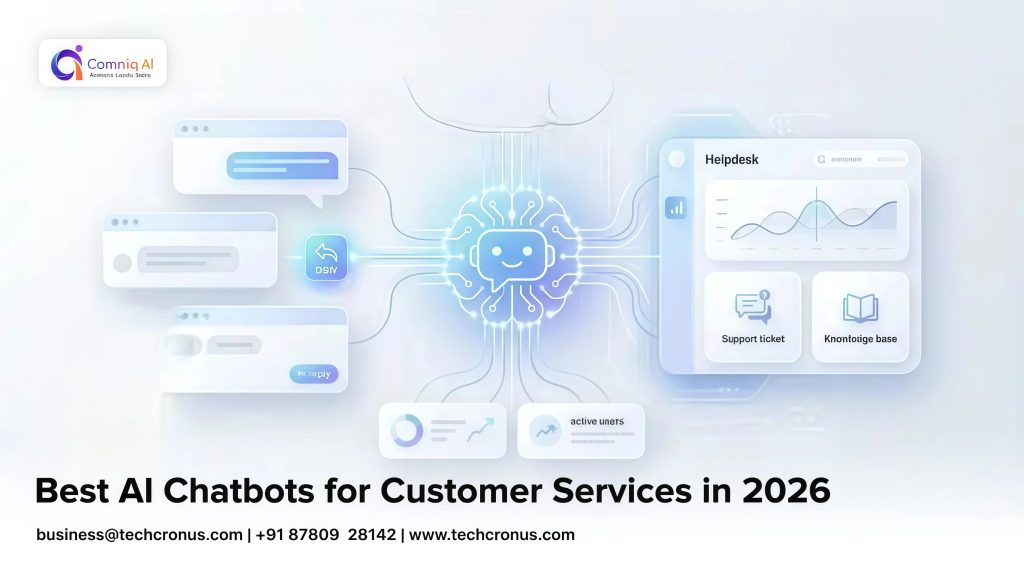
AI customer support software leverages artificial intelligence, machine learning, and natural language processing to automate customer interactions, streamline workflows, and enhance agent productivity. Unlike traditional chatbots that frustrate customers by forcing escalation for anything requiring action, generative AI agents resolve issues end-to-end.
Modern AI helpdesk platforms go far beyond simple chatbots. They use advanced algorithms to automatically categorize requests, suggest solutions, and even resolve common issues without human intervention. These systems understand context, learn from customer interactions, and continuously improve their responses, capabilities that fundamentally distinguish them from rule-based traditional systems.
Key features of AI-powered helpdesk software include:
- Intelligent ticket routing based on intent and urgency
- Automated responses for repetitive queries
- Sentiment analysis to detect customer emotions
- Multilingual support across global time zones
- Predictive analytics for proactive issue resolution
- 24/7 availability without additional staffing costs
Traditional Helpdesk: Understanding the Limitations
Traditional helpdesk systems organize customer inquiries through ticket-based workflows, enabling collaboration among support agents and tracking issues through resolution. While these systems have served businesses for decades, they face significant challenges in meeting modern customer expectations.
Traditional bulky helpdesk systems miss the mark on several accounts. The very fact that they are designed to handle anything and everything makes them heavy, bulky, slow, and complex. Common limitations include:
Manual Processing Bottlenecks: Manual handling of a help desk ticket costs an average of $22 per interaction. Support teams spend excessive time on repetitive tasks like password resets and access requests, work that AI agents can handle autonomously.
Scalability Challenges: As ticket volumes increase, traditional helpdesks require proportional increases in headcount. This creates a difficult equation: hire more agents and costs spiral, or maintain current staffing and watch response times deteriorate.
Limited Coverage Hours: Expanding coverage into other time zones increases challenges, with peaks and valleys in coverage making it difficult to justify the cost of extra personnel for off-hours.
Inconsistent Service Quality: As support teams grow, consistency becomes harder to maintain, new agents respond differently, processes drift, and quality varies.
The AI Advantage: Measurable Business Impact
The shift to AI-powered customer support isn’t theoretical, organizations implementing these solutions report dramatic, measurable improvements across key performance indicators.
Cost Reduction and ROI
Companies are seeing average returns of $3.50 for every $1 invested in AI customer service, with leading organizations achieving up to 8x ROI. This financial impact stems from multiple sources:
- Lower cost per ticket: AI resolution costs approximately $0.99-$2.00 versus human tickets at $6-12
- Reduced labor costs: According to a Forrester Consulting study, companies using voice AI report a three-year ROI between 331% and 391%, with a composite organization saving $10.3 million in agent labor costs over three years
- Faster payback periods: Modeled customers achieved 210% ROI over three years with payback periods under 6 months
Operational Efficiency Gains
First response time for tickets has dropped from over 6 hours to less than 4 minutes with AI-powered support, while AI has helped slash resolution times from nearly 32 hours to just 32 minutes.
Additional efficiency metrics include:
- Agent productivity: Support agent productivity increases 14% with generative AI assistance
- Ticket deflection: AI agents now deflect over 45% of incoming customer queries, with retail and travel companies seeing deflection rates above 50%
- Automation at scale: An AI assistant can handle 2.3 million conversations monthly, equivalent to 700 full-time agents
Customer Satisfaction Improvements
Customer satisfaction has climbed from 89% to 99% thanks to AI implementation. This improvement stems from faster response times, consistent service quality, and 24/7 availability that traditional helpdesks cannot match without significant cost increases.
When Traditional Helpdesk Still Makes Sense
Despite AI’s advantages, traditional helpdesk solutions remain appropriate for specific scenarios:
Complex, High-Touch Service Requirements: Businesses handling sensitive issues requiring deep human judgment, empathy, and nuanced decision-making may benefit from human-centric approaches.
Small Teams with Low Volume: Organizations processing fewer than 100 support tickets monthly may not justify AI implementation costs.
Highly Regulated Industries: Some sectors with strict compliance requirements may need human oversight for every customer interaction.
Limited Technical Resources: Companies without the technical infrastructure to support AI integration may find traditional systems more manageable initially.
The Hybrid Approach: Best of Both Worlds
Forward-thinking organizations increasingly adopt hybrid models combining AI efficiency with human expertise. 75% of CX leaders expect that 80% of customer interactions will be resolved without a human agent in the next few years, but this doesn’t eliminate the need for skilled human agents, it elevates their role.
In hybrid systems, AI handles routine inquiries instantly while complex issues seamlessly escalate to human agents with full context preserved. This approach delivers:
- Immediate response for common questions
- Human expertise for complex problems
- Cost efficiency through intelligent triage
- Scalability without proportional headcount increases
For businesses seeking this balanced approach, platforms like ComniqAI offer comprehensive solutions designed around real business workflows. The ComniqAI AI Chatbot Platform integrates directly with CRMs, ticketing systems, and sales pipelines, ensuring zero data loss while cutting response time and improving first-contact resolution. What sets ComniqAI apart is its ability to understand intent, respond in multiple languages, qualify leads, and route complex issues smoothly, functioning as both a customer service chatbot and lead generation tool in one unified system.
Key Considerations for Your Decision
When evaluating AI customer support software versus traditional helpdesk solutions, consider these critical factors:
Current Ticket Volume: Organizations handling high-volume, routine inquiries see the fastest AI payback, with deflection rates starting at 20-40% on Day 1 and growing to 60%+ over 6-12 months.
Budget Constraints: At a 60% containment rate, achievable within the first few months of deployment, a business handling 10,000 tickets monthly at $8 average cost saves $48,000 monthly.
Customer Expectations: 90% of leading CX organizations believe that AI and automation will soon resolve 8 out of 10 customer issues without human intervention.
Implementation Timeline: Traditional helpdesk deployment is faster but offers limited automation. AI implementation requires more upfront investment but delivers compounding returns over time.
The Future of Customer Support: 2026 and Beyond
Gartner predicts organizations will replace 20% to 30% of their service agents with generative AI by 2026, but this shift represents evolution, not elimination. The best teams don’t use AI to avoid customers; they use it to speed up the time it takes to resolve issues by automating triage, summarizing every interaction, and guiding agents in real time.
Emerging trends shaping customer support include:
- Agentic AI capable of executing actions autonomously
- Voice AI with human-like natural speech understanding
- Multimodal support across text, voice, and visual channels
- Predictive assistance anticipates customer needs before they arise
The question for businesses isn’t whether to adopt AI, but how quickly to implement it strategically.
Making the Right Choice
AI customer support software delivers measurable advantages over traditional helpdesk systems in cost reduction, operational efficiency, and customer satisfaction. The AI customer service market’s explosive expansion at 23.2% CAGR reflects decisive shift from manual support operations to AI-native architectures as organizations recognize that customer service automation has matured from experimental technology to competitive necessity.
For most businesses, the optimal path forward combines AI automation for routine interactions with human expertise for complex issues. This hybrid approach delivers the speed and scalability customers demand while preserving the empathy and judgment that builds lasting relationships.
The choice between AI and traditional helpdesk isn’t binary, it’s strategic. Evaluate your current challenges, customer expectations, and growth trajectory to determine which solution positions your organization for success in an increasingly AI-powered customer service landscape.