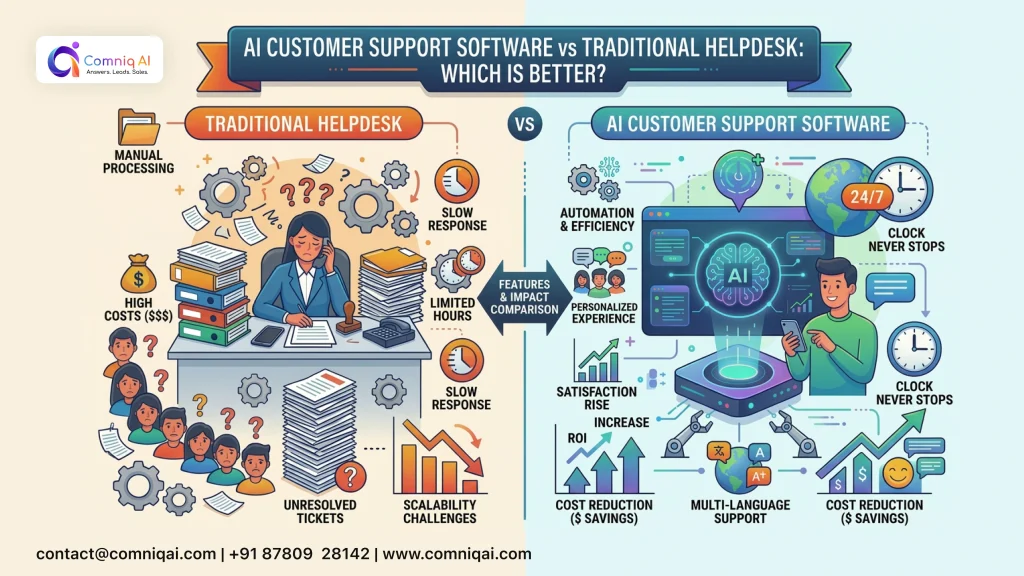
Australian e-commerce does not close at 5 PM.
Customers browse, compare products, ask questions and make purchase decisions late at night, on weekends and across different Australian time zones. Yet many retail support teams still operate around conventional business hours.
That creates a costly gap between when customers need help and when businesses are available to provide it.
For Australian retailers, AI customer support Australia is increasingly becoming a practical way to close that gap. The right AI system can answer routine questions = 24/7 AI Support, support product discovery, automate repetitive enquiries and hand complex conversations to human agents.
The opportunity is significant because Australian online retail is already operating at enormous scale. Australia Post reports that Australians spent A$82.6 billion online in 2025, up 14% year-on-year, with 9.8 million households shopping online.
At the same time, 62% of Australian shoppers use AI, according to Australia Post’s 2026 E-commerce Report.
The implication is straightforward: Your customers are increasingly comfortable using AI. They may also expect your business to provide faster digital assistance.
The After-Hours Customer Support Problem
Suppose an Australian customer visits an online store at 10:45 PM. They find the product they want. Later they have three questions:
- Is it available in my size?
- How quickly will it reach Brisbane?
- Can I return it if it does not fit?
Nobody from the support team is online. The customer can wait until morning. Or they can open another retailer’s website. This is not necessarily a pricing problem. It is a response-time problem.
A well-designed AI chatbot for Australian retailers can provide immediate first-line assistance during those otherwise uncovered hours. The objective is not to eliminate human customer service. It is to make sure humans are spending their time on conversations that actually require human judgement.
Why Australian E-commerce Makes 24/7 Support More Important
Online shopping has changed customer expectations. A physical store has an obvious opening and closing time. An e-commerce website does not.
Australia Post’s 2026 research shows that Australians are shopping online frequently and across more retailers. The average household now shops across around 16 different retailers each year, increasing the pressure on businesses to deliver a smooth experience beyond the initial sale.
That makes customer support part of the competitive experience.
A customer who receives an immediate, useful answer at 11 PM may continue towards checkout.
A customer who receives: “Our team will respond tomorrow.” — may simply leave.
This is where AI customer support for Australian retailers becomes commercially relevant.
The Australian Time-Zone Challenge
Australia itself spans multiple time zones. A retailer serving customers nationally may already have customers shopping outside its support team’s primary operating hours.
International e-commerce adds another layer. Australian retailers can also receive enquiries from New Zealand, Singapore, the United Kingdom, the United States and other markets.
Hiring people to cover every hour can become expensive. Offshore support can extend coverage, but it can also introduce:
- Training costs
- Management overhead
- Quality variation
- Staff turnover
- Knowledge-transfer challenges
- Escalation delays
- Brand-consistency issues
AI offers another model: AI handles predictable conversations. Humans handle complexity.
This hybrid approach is often more commercially sensible than treating AI as an all-or-nothing replacement for people.
Three Customer-Support Models for Australian Retailers
| Model | Availability | Human dependency | Scalability | Typical limitation |
| In-house support | Mainly business hours | High | Low–Medium | Limited coverage |
| Offshore support | Extended/24-hour | High | Medium | Cost and consistency |
| AI + human hybrid | 24/7 first-line | Targeted | High | Requires proper implementation |
The key question these days is — “Which conversations genuinely need a human?” And this produces a much better automation strategy.
What Can an AI Customer Support System Handle?
A modern AI chatbot for Australian e-commerce can potentially support customers with repetitive, information-based enquiries such as:
Product Questions
Customers can ask about:
- Sizes
- Colours
- Materials
- Specifications
- Compatibility
- Product differences
- Availability
Delivery Questions
The assistant can explain approved information about:
- Delivery options
- Shipping regions
- Dispatch processes
- Delivery estimates
- Tracking
- Delivery policies
Returns and Exchanges
AI can explain approved procedures involving:
- Return windows
- Exchanges
- Refund processes
- Eligibility
- Required steps
Order Support
When integrated with appropriate systems, AI can potentially help customers with:
- Order status
- Tracking
- Delivery updates
- Order-related questions
Store Policies
Instead of searching through multiple pages, customers can ask questions naturally.
That makes a 24/7 customer support chatbot Australia retailer deploys considerably more useful than a static FAQ page.
AI Should Not Replace Your Customer Service Team
The strongest retail AI strategy is usually not: AI versus humans.
It is: AI + humans.
AI is particularly useful for repetitive questions. Human agents remain important for:
- Complaints
- Disputes
- Complex refunds
- Warranty issues
- Exceptions
- Sensitive matters
- High-value customers
- Escalations
- Situations requiring discretion
This approach can help businesses reduce offshore support costs AI Australia retailers may currently incur while retaining human expertise where it matters. The goal is appropriate automation, not maximum automation.
How 24/7 AI Support Works
Consider an Australian retailer receiving an enquiry at 11:38 PM.
Customer: “Is the black jacket available in medium?”
AI: Checks approved product information.
Customer: “Can you deliver it to Brisbane?”
AI: Provides approved delivery information.
Customer: “What happens if it does not fit?”
AI: Explains the approved returns policy.
Customer: “I have already ordered one and need to change the address.”
The conversation now requires access to order information or human intervention. The AI should escalate rather than improvise. That is the foundation of a responsible e-commerce customer support automation Australia strategy.
The Real Business Case: Speed, Workload and Revenue
Retailers should not measure AI only by the number of chats handled. The more important metrics are:
- After-hours enquiry volume
- AI resolution rate
- Human escalation rate
- First-response time
- Assisted conversions
- Average handling time
- Cost per resolved interaction
- Customer satisfaction
- Repeat contacts
- AI error rate
A Practical ROI Example
A retailer receives 2,000 after-hours enquiries per month. Suppose 60% are repetitive and potentially suitable for automation. That equals: 1,200 potentially automatize interactions.
If the retailer’s hypothetical fully loaded human handling cost were A$6 per interaction: 1,200 × A$6 = A$7,200
Now this represents a theoretical monthly workload value, not a promised saving.
Actual ROI depends on AI accuracy, escalation, staffing structure, implementation costs and the proportion of conversations that genuinely require humans. The correct approach is to establish the retailer’s baseline before deployment.
Why AI Can Matter During Peak Retail Periods
- Black Friday,
- Christmas,
- EOFY,
- Flash sales,
- Product launches…and so on and so forth…
These times can create sudden support spikes. Your website can handle thousands of visitors simultaneously. But your support team may or may not necessarily scale at the same speed.
An AI chatbot for Australian retailers can provide an additional first-line support layer when enquiry volumes rise. Australia Post reported that 7.6 million Australian households shopped online during November and December 2024, while 103 million parcels were delivered during that peak period. Hope you understand now why scalable customer communication matters during high-demand periods. It instantly reduces support costs.
AI Is Also Becoming Part of the Shopping Journey
Customer support is no longer completely separate from sales.
A customer asked: “Which of these is better for a small apartment?” — may not really be seeking customer service. They may be deciding whether to buy.
Australia Post reports that 62% of shoppers use AI, while its research also shows growing use of AI for shopping advice and product discovery.
This creates a new opportunity. A properly grounded AI assistant can potentially move the customer from:
Question → Product information → Comparison → Confidence → Purchase
In short, you have the AI customer support part of the broader e-commerce conversion journey.
Australian Privacy Cannot Be an Afterthought
AI customer support can involve personal information. That makes privacy part of implementation—not a box to tick afterwards.
The OAIC’s 2026 Australian Community Attitudes to Privacy Survey found that 93% of Australians consider protecting personal information important, while 69% recognise AI as a privacy risk. Only 4% trust AI companies.
The same research found that Australians prioritise protections such as:
- Human review
- Limits on third-party retention
- Being told when AI is being used
A responsible retail implementation should therefore consider:
- Data minimization
- Transparency
- Access controls
- Retention
- Vendor due diligence
- Human oversight
- Security
- Escalation
The OAIC also reports that Australians are more accepting of data collection when the purpose is clear, consent is available and only necessary information is collected.
For Australian retailers, trust is part of the product experience.
AI Customer Support Must Respect Australian Consumer Law
Automation cannot be used to make legitimate customer complaints disappear.
Australian online businesses remain subject to consumer law, including consumer guarantees. The ACCC states that businesses selling online must comply with consumer guarantees and must not make false or misleading claims.
Therefore, AI should help customers understand approved processes rather than invent restrictions. Read more here above AI vs LIVE CHAT.
A 30-Day AI Customer Support Pilot
Retailers do not need to automate everything immediately.
Week 1: Audit
Analyse 60–90 days of support conversations. Identify the most common enquiries.
Week 2: Knowledge and Guardrails
Create approved answers. Define what AI can answer. Define what AI must escalate.
Week 3: Controlled Launch
Deploy selected support categories. Monitor conversations closely.
Week 4: Measure
Review:
- Resolution
- Escalation
- Accuracy
- Response time
- Customer feedback
- Conversion influence
- Human workload
- Messaging Automation
Then expand based on evidence.
The 7 Questions to Ask Before Buying an AI Chatbot
- Can the e-commerce chatbot use our approved knowledge?
- Will it integrate with our e-commerce systems?
- Can customers connect to human support also?
- Will we be able to control what it can answer and that too accurately?
- Can conversations be monitored?
- How do we measure business outcomes?
- Can privacy and data handling be clearly assessed?
If a provider cannot answer these questions clearly, investigate before implementation.
Why ComniqAI for Australian Retailers?
ComniqAI approaches AI customer support as a business-process problem rather than simply a chatbot deployment.
The starting question is not: “Which chatbot should we install?”
It is: “Where is your customer-support workload actually coming from?”
Following approach creates a more useful AI strategy than simply adding a chatbot widget:
- Customer Journey: Where do customers need assistance before and after purchase?
- Conversation Data: Which questions consume the most human time?
- Business Rules: Which conversations are safe to automate?
- Technology: Which e-commerce, CRM, helpdesk and knowledge systems need integration?
- Governance: What information should AI access?
- Escalation: When should AI transfer the conversation?
- Measurement: How will commercial impact be calculated?
Is Your Retail Business Ready for AI Customer Support?
You may be a strong candidate if:
✓ Customers contact you after hours.
✓ Your team repeatedly answers the same questions.
✓ Offshore support costs continue to rise.
✓ Customers ask product questions before buying.
✓ Support volume increases during promotions.
✓ Your team spends too much time on repetitive enquiries.
✓ You want 24/7 first-line assistance without staffing every hour.
If several apply, an AI support assessment can identify where automation could create measurable value.
Get the ComniqAI After-Hours Support Audit
Not sure whether AI can actually reduce your support workload?
ComniqAI can assess your current customer-support operation and identify:
- Your highest-volume support questions
- After-hours support gaps
- Potential automation opportunities
- Human escalation requirements
- E-commerce integration needs
- Privacy considerations
- Potential ROI metrics
- A practical 30-day implementation roadmap
The goal is to identify whether AI makes commercial sense for your business, and where it should be deployed first. Request an AI Customer Support Assessment from ComniqAI.
Find out which customer conversations your business can automate, what integrations are required and where AI can create measurable support and revenue efficiencies.
Frequently Asked Questions
What is AI customer support for Australian retailers?
AI customer support Australia refers to AI-powered systems that answer customer questions, provide approved business information, automate routine support and escalate complex interactions to human teams.
Can an AI chatbot provide 24/7 support?
Yes. A 24/7 customer support chatbot Australia retailer deploys can remain available outside normal business hours, including nights, weekends and public holidays.
Can an AI chatbot work with Shopify?
Depending on the implementation, an AI chatbot for Australian e-commerce can be integrated with Shopify and other e-commerce technologies to support customer-service workflows.
Can AI replace an offshore customer support team?
An AI chatbot replace offshore support team Australia strategy should not automatically mean eliminating human support. A hybrid model can automate repetitive interactions while humans manage complex cases.
What does e-commerce customer support automation involve?
E-commerce customer support automation Australia businesses use can include AI-powered FAQs, product questions, delivery information, order support, returns guidance, escalation and customer-service workflows.
Is AI customer support suitable for small Australian retailers?
Yes. The appropriate solution depends on customer volume, product complexity, support workload, e-commerce platform and integration requirements.
Is AI customer support safe for Australian customer data?
It can be implemented responsibly, but retailers should assess privacy, security, data handling, access controls, retention and third-party processing before deployment. Australian privacy guidance should be considered when AI processes personal information.
What is the best AI chatbot for an Australian online store?
The Best AI chatbot for Australian online stores is the one that provides accurate answers, integrates with the retailer’s systems, supports human escalation, protects customer information and produces measurable business outcomes.
How much does an AI customer-support chatbot cost?
There is no single price. Cost depends on conversation volume, AI model, integrations, knowledge-base complexity, channels, automation requirements and ongoing support. A retailer should calculate cost against support workload and commercial impact rather than comparing software subscriptions alone.
What should an AI chatbot do when it does not know an answer?
It should not guess. It should explain that it cannot confidently answer, provide available approved information and escalate to a human where appropriate.
When should a retailer start implementing AI customer support?
Retailers should begin when repetitive support volume, after-hours demand or offshore support costs create a measurable business problem. A controlled pilot can establish ROI before broader deployment.