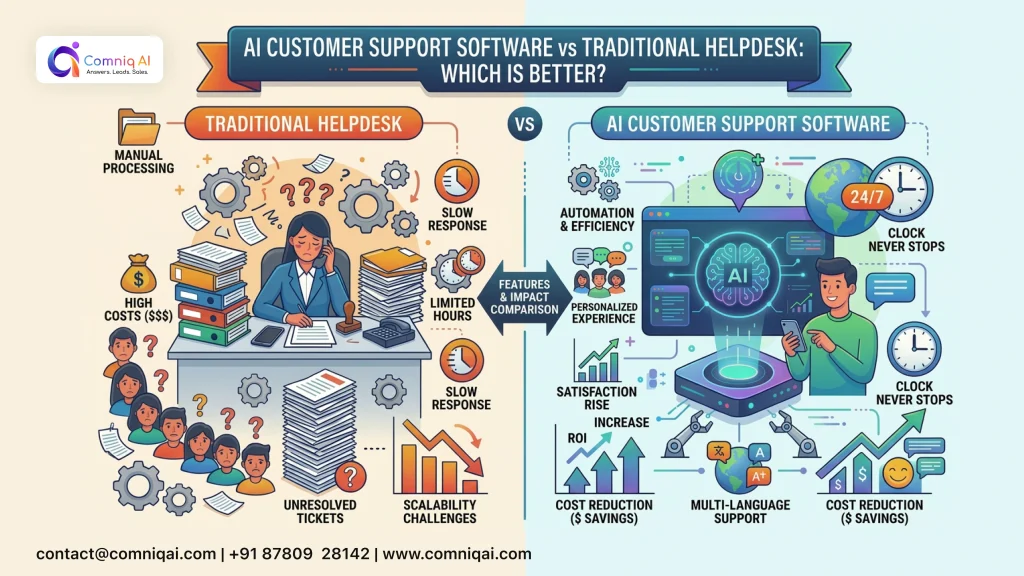
Customer expectations have never been higher. Today’s consumers want instant answers, personalized experiences, and seamless support, around the clock. Traditional support models simply cannot scale to meet this demand without skyrocketing operational costs. That’s exactly where customer service AI agents come in.
AI agents are no longer a futuristic concept. According to Statista, around 67% of companies planned to adopt AI agents in their workflows by 2025. Unlike rule-based chatbots that follow rigid scripts, modern AI support agents can reason, decide, and take autonomous action across complex, multi-step support scenarios. They’re reshaping how businesses engage with customers, and the results speak for themselves.
In this article, we break down the most impactful use cases of AI agents in customer support, and explain how they’re delivering measurable value for businesses of all sizes.
What Are Customer Service AI Agents?
Before diving into use cases, it’s important to understand what sets AI agents apart from traditional support tools.
A customer support AI agent is an intelligent system powered by machine learning (ML) and natural language processing (NLP). It doesn’t just retrieve canned responses, it understands intent, even when phrasing is complex or indirect. It learns from past interactions, adapts to evolving customer needs, and can operate autonomously across multiple systems simultaneously.
Think of it as a “digital worker”, one that never sleeps, never gets frustrated, and gets smarter over time.
Top Use Cases of AI Agents in Customer Support
1. 24/7 Intelligent Self-Service and Query Resolution
One of the most immediate and high-impact use cases of an AI chatbot for customer service is always-on self-service support. Customers can get accurate answers to questions about orders, accounts, product features, billing, and more, at any time of day, without waiting in a queue.
Unlike older chatbots that deflect rather than resolve, modern AI agents understand nuance. They pull from knowledge bases, CRM data, and past interaction history to deliver personalized, accurate responses. If a query exceeds their scope, they escalate it to a human agent with the full conversation context intact, ensuring nothing is lost in translation.
This reduces ticket volume significantly while improving customer satisfaction scores (CSAT).
2. Intelligent Ticket Routing and Prioritization
Support teams waste enormous time manually sorting, tagging, and routing tickets to the right agent. AI agents in customer service eliminate this friction entirely.
Using ML models, AI agents can analyze incoming tickets in real time, predict their priority level, identify the customer’s intent, and route them to the best-qualified human agent, all before a human even touches the ticket. This means high-priority or high-sentiment tickets get faster attention, while routine queries are handled autonomously.
The outcome? Faster resolution times, more efficient team utilization, and a better overall experience for both customers and agents.
3. Proactive Sentiment Analysis and Escalation Prevention
The best support isn’t reactive, it’s proactive. Customer service AI agents equipped with sentiment analysis capabilities can monitor live conversations in real time, detect frustration, urgency, or dissatisfaction, and flag tickets that are likely to escalate before they do.
This enables support managers to intervene at the right moment, assign experienced agents to sensitive cases, and prevent churn from happening. AI agents can also analyze historical interaction patterns to identify recurring pain points that need to be addressed at the product or policy level.
This shifts support from a cost center to a strategic function that actively protects customer relationships.
4. Agent Assist – Empowering Human Support Teams
AI doesn’t just replace human agents, it makes them dramatically more effective. This is where AI support agents act as real-time co-pilots for your human team.
During a live interaction, an AI agent can surface relevant knowledge base articles, suggest next-best responses, pull up CRM data, summarize prior conversations, and recommend next actions, all within the agent’s existing helpdesk interface. This eliminates the need for agents to manually search through systems and lets them focus on what they do best: delivering empathetic, high-quality support.
Companies using agent-assist AI tools have seen significant reductions in average handle time (AHT) and improvements in first-contact resolution (FCR) rates.
5. Automated Workflows and Backend Task Execution
Modern AI agents service use cases go well beyond conversation. Agentic AI can autonomously execute multi-step backend workflows, such as processing a refund, updating account information, canceling a subscription, or creating a support ticket, without requiring human intervention.
This is a fundamental shift. Rather than an AI simply gathering information and handing it to a human to act on, agentic AI completes the task end to end. It connects to CRM systems, billing platforms, e-commerce tools, and internal databases to carry out actions on the customer’s behalf in real time.
For high-volume support environments, this level of automation translates directly into cost savings and capacity gains.
6. Omnichannel Support Across Chat, Email, and Voice
Today’s customers engage across multiple channels, live chat, email, social media, phone, and messaging apps. A disconnected support experience across these channels is a major source of customer frustration.
Customer support AI agents solve this by delivering consistent, context-aware support across all channels from a unified platform. Whether a customer starts a conversation on chat and continues it via email, the AI agent retains full context and history. This omnichannel continuity is one of the biggest differentiators of modern AI-powered support.
Voice AI agents are also becoming increasingly sophisticated, capable of natural, interruption-friendly conversations, multilingual support, and real-time intent recognition during phone calls.
7. Knowledge Management and Continuous Learning
Support teams frequently struggle with outdated knowledge bases, information silos, and inconsistent answers across agents. AI agents address this by automatically tagging, categorizing, and indexing support content, and by identifying knowledge gaps from customer interactions.
When an AI agent notices that a particular query type is generating incorrect or incomplete responses, it flags it for review and suggests new knowledge articles to fill the gap. This keeps the knowledge base up to date, reduces agent training overhead, and ensures customers receive accurate answers regardless of channel.
8. Quality Assurance and Compliance Monitoring
Maintaining consistent service quality across a large support team is a constant operational challenge. AI agents can automatically audit customer interactions, evaluating tone, resolution accuracy, process adherence, and compliance with internal guidelines, at scale.
Rather than manually reviewing a small sample of interactions, QA teams can now analyze 100% of conversations using AI, uncovering coaching opportunities, policy violations, and personalization gaps that would have otherwise gone undetected.
Why Businesses Are Investing in AI Support Agents Now
The business case for customer service AI agents is compelling and multidimensional:
- Scalability: AI agents handle thousands of simultaneous conversations without additional headcount.
- Cost efficiency: Automating routine interactions reduces operational costs substantially.
- Speed: Customers get instant responses; resolution times drop dramatically.
- Consistency: Every customer receives the same quality of service, every time.
- Data-driven insights: AI agents generate rich interaction data that informs strategy, product improvements, and service design.
Getting Started with AI Agents in Customer Support
Implementing AI in your support stack doesn’t have to be overwhelming. Start by mapping your current workflows and identifying where the highest volume of routine, repetitive interactions occurs. These are your best candidates for AI automation.
From there, choose an AI platform that integrates with your existing helpdesk and CRM, supports your key channels, and offers clear escalation logic. Pilot one use case, measure the impact, and scale from there.
Comniq AI for Smart Customer Support
One platform worth exploring is Comniq AI, a purpose-built AI chatbot solution designed specifically for customer service teams. Unlike generic automation tools, Comniq AI is trained to handle real customer conversations, not just scripted reply trees. It understands customer intent, automates common support queries, and intelligently routes conversations to human agents when the situation calls for it, all without requiring a single line of code.
What makes Comniq AI a strong fit for growing businesses is its focus on response quality alongside efficiency. It doesn’t just deflect tickets; it resolves them. By combining NLP-driven intent recognition with your existing support content and CRM data, Comniq AI delivers accurate, personalized answers that feel human, helping teams reduce workload while keeping customer satisfaction high. Whether you’re a startup handling your first spike in support volume or an established business looking to scale without scaling headcount, Comniq AI provides an enterprise-ready foundation to get started fast.
You can also explore related insights on the ComniqAI blog, including how AI chatbots help companies cut support costs, what to look for in the best AI chatbots for customer service, and how to overcome customer support challenges for online businesses.
Final Thoughts
AI agents are no longer a nice-to-have, they’re a competitive necessity. From intelligent self-service and proactive escalation to backend task automation and quality assurance, the use cases of customer service AI agents are broad, proven, and growing.
The businesses that invest in this technology now will be the ones delivering faster, smarter, and more personalized support experiences tomorrow. The question isn’t whether to adopt AI in your support operations, it’s how quickly you can get started. Ready to see what AI agents can do for your customer support team? Explore ComniqAI and start building smarter support experiences today.